

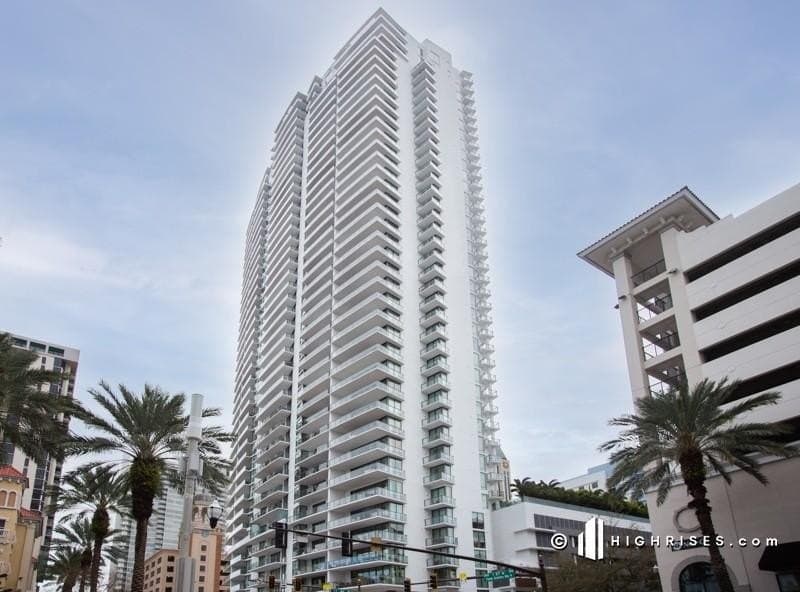
Active New Construction Projects in Downtown St. Pete (2026)
The Sage — A contemporary luxury tower delivering a distinctive design sensibility at price points below ONE St. Petersburg. Residences feature high-end finishes, chef's kitchens, and resort-style amenities. Strong interest from remote-work professionals and buyers under 50 who want a modern aesthetic. Pricing: $600K–$2.5M+.
400 Central — Completed in 2025 and now the tallest tower in St. Petersburg at 42 stories and 244 residences, steps from Beach Drive dining, the waterfront, and the Cultural Center. Developer inventory remains available alongside early resales, which is unusual this soon after delivery and gives buyers a rare choice between a developer contract and a closed unit. Minimum lease is 6 months. Pricing: $700K–$3M+ depending on floor and configuration.
The Art House — Also delivered in 2025, at 275 1st Ave S in the Edge District side of downtown. A significant number of resales are on the market, so buyers have more negotiating room here than in a building still selling through developer inventory. Minimum lease is 6 months.
Saltaire — 192 luxury residences now fully delivered. Select resale units from original buyers are available — providing a near-new alternative without developer contract risk. Typically priced $800K–$3M on the resale market.
Important note: Pre-construction timelines, pricing, and availability change rapidly. The developer's sales center agents represent the developer, not you. Contact our team for current unbiased status on each project.
New Construction vs. Resale: When Each Makes Sense
Choose new construction when:
- Customization matters — finish selections, layout modifications, and upgrade packages are available during the pre-construction period
- You want to avoid legacy HOA issues. Post-SB 4-D, older buildings face significant reserve funding requirements and potential special assessments. New buildings start with full funded reserves.
- Technology priorities: new construction includes modern HVAC, EV charging infrastructure, smart home pre-wiring, and high-speed connectivity that older buildings cannot easily retrofit
- You have timeline flexibility — new construction requires 6–24 months from contract to delivery
- Warranty protection: developer warranties typically run 1–3 years on systems and 10 years on structural elements
Choose resale when:
- You need to occupy within 60–90 days
- You want to negotiate price — developer contracts rarely offer price flexibility the way motivated individual sellers do
- You prefer a specific floor or view not available in new construction
- Value matters — well-maintained resale condos in ONE, Vinoy Place, and Parkshore Plaza often represent better value per square foot than new construction at equivalent quality
Understanding Developer Contracts: Key Provisions
Developer contracts are written by the developer's attorneys to protect the developer. Key provisions to understand and negotiate:
- Price guarantee: Some contracts allow price increases between signing and closing. Confirm your purchase price is locked.
- Deposit structure: Typically 10–20% paid in tranches tied to construction milestones. Understand what portion is at risk if you cannot close.
- Change order costs: Upgrades beyond the standard package can add 10–30% to the base price. Get all upgrade pricing in writing before execution.
- Delivery timeline flexibility: Developers typically retain broad flexibility on delivery timing. Know your rights if delivery is significantly delayed.
- Material substitution rights: Developers can often substitute "equivalent" materials. Negotiate specific protection for specified finishes.
- HOA document disclosure: Florida law requires developers to provide condo documents and estimated budgets before contract. Read everything — it becomes binding after closing.
Financing New Construction Condos in Florida
Financing new construction involves additional complexity compared to resale transactions:
Warrantability: Fannie Mae and Freddie Mac have specific criteria for condo eligibility. Projects less than 51% sold, with high investor concentration, or with certain HOA structures may be "non-warrantable," requiring portfolio loans at higher rates (typically 0.5–1.5% above conventional).
Rate lock timing: Most buyers use a pre-approval during construction but do not lock their rate until 60–90 days before delivery. Given 12–24 month timelines, early rate locks create risk if rates shift. This requires careful coordination with your lender.
Appraisal risk: If the appraised value at delivery is below your contract price, you are responsible for making up the difference in cash. In rising markets this is less common; in flat or declining markets it is a real risk. Build contingency planning into your budget.
Use a mortgage broker who specializes in Florida new construction condo financing. The warrantability and project approval nuances can make the difference between a smooth closing and a last-minute financing crisis.
SB 4-D and New Construction: Why New Builds Have a Financial Advantage
Florida's Senate Bill 4-D (codified as HB 1021) created sweeping new requirements for condo buildings following the 2021 Champlain Towers collapse:
- Buildings 3+ stories within 3 miles of the coast must complete milestone structural inspections at 30 years (25 for coastal) and every 10 years thereafter
- All condo associations must maintain fully funded reserves for structural components by January 1, 2026
- Special assessments for underfunded reserves are hitting legacy buildings hard — some owners in older downtown St. Pete buildings have received assessments of $20,000–$80,000+ per unit
New construction buildings start with a significant structural and financial advantage: new buildings have current structural condition, new mechanical systems, and developer-funded initial reserves that older buildings must now rebuild. For buyers concerned about HOA stability and future special assessments, new construction offers the cleanest balance sheet.
Why You Need a Buyer's Agent at a New Construction Sales Center
Many buyers go directly to the developer's sales center without representation, believing they save money. This is almost always incorrect. Developer sales agents represent the developer — their job is to close the transaction at the best terms for the developer, not to advise you.
A buyer's agent who tracks the new construction market will know:
- Which projects are offering incentives (upgraded finishes, rate buydowns, premium parking) that are not publicly advertised
- Which buildings have the strongest sales velocity — and which are slow, indicating pricing issues
- How the developer contract compares to market norms
- Whether the developer is financially sound and the project is on schedule
In most cases, the developer pays the buyer's agent commission — meaning you receive professional representation at no direct cost. There is no rational reason to enter a developer negotiation unrepresented.
The Gas Plant District: The Largest Project on the Horizon
No discussion of new construction downtown is complete without the Gas Plant District — a multi-phase redevelopment centered on the area around the former Tropicana Field site, and widely regarded as one of the largest urban mixed-use projects in Florida history. It is led by Hines, a major international developer, and the Tampa Bay Rays stadium question has been a central component of planning discussions throughout.
- Scale — hundreds of acres near the downtown core, spanning multiple phases
- Uses — thousands of residential units plus retail, entertainment venues, hospitality, and office space
- Timeline — full buildout will take a decade or more
The honest way to weigh this as a buyer: treat it as a long-term value driver for all of downtown, not just the immediate blocks around the site. It will reshape the western edge of downtown and support demand for both new and existing residential property nearby. But it is not a reason to overpay today for a unit whose thesis depends on a project that will not finish for ten years. If a listing is priced on Gas Plant optimism rather than present-day comparables, that is a negotiation point, not a premium to accept.