

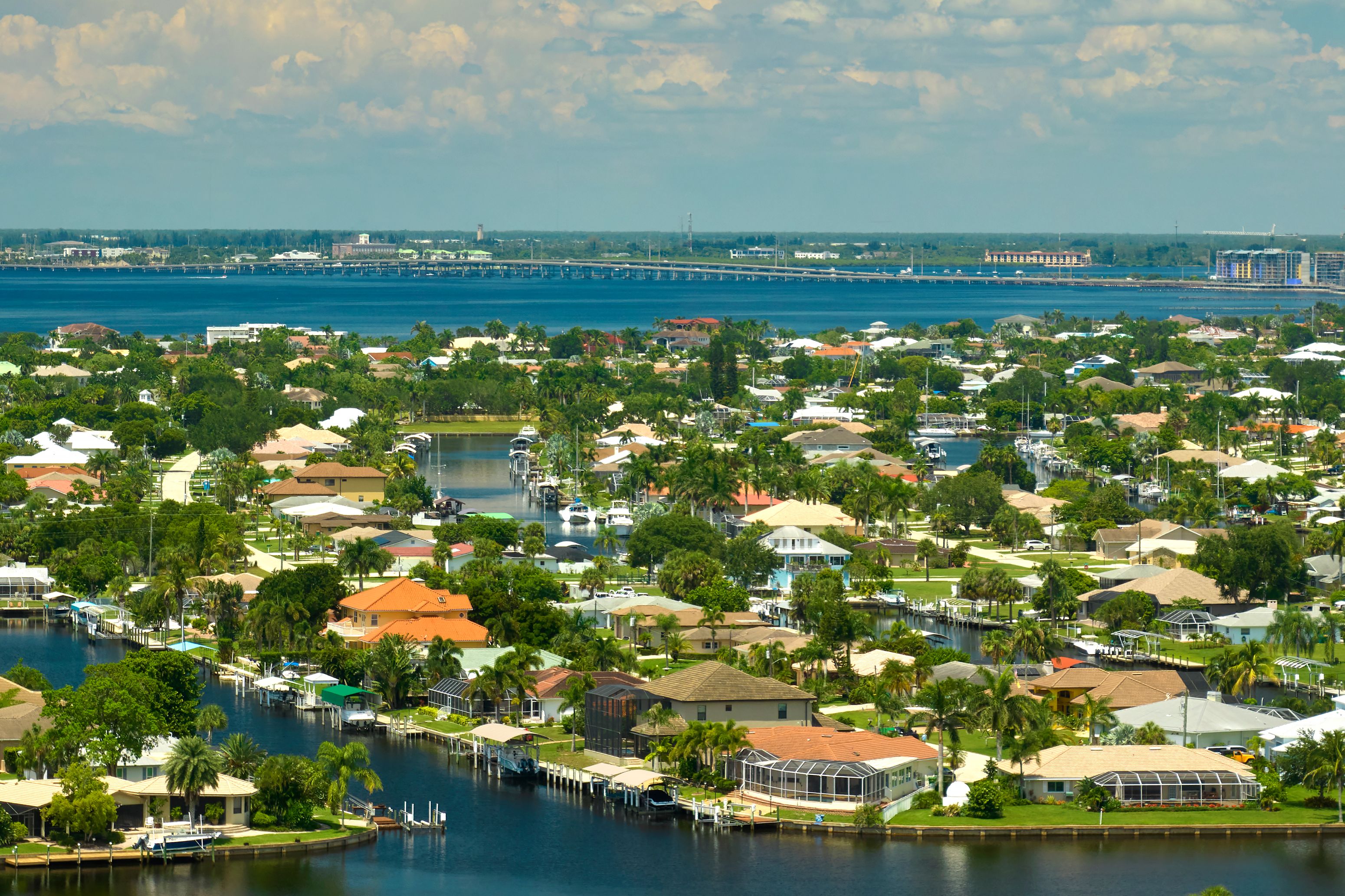
You found the house. Water views, dock, the whole thing. Then the flood quote came back at two or three times what the listing said to expect.
That gap is not a mistake. It is the difference between what the current owner pays and what you will pay after closing, and almost nobody explains it before you are already under contract.
By the end of this guide you will know the real flood insurance cost in St. Petersburg by flood zone, the five factors that actually move your premium, how NFIP and private flood coverage compare on a waterfront home, and the two local rules that catch more St. Pete buyers than anything else.
What Flood Insurance Actually Costs in St. Petersburg Right Now
Flood insurance in St. Petersburg averages about $1,559 per year, or roughly $130 per month, through the National Flood Insurance Program. That sits above the Pinellas County average of $1,392 and well above the Florida statewide average of $938. Waterfront and barrier island homes routinely pay several times that figure.
Those averages come from NerdWallet's May 2026 analysis of NFIP policy data, which calculated county and city averages from the program's own Policy Information by State report.
The zone matters more than the city. Statewide NFIP averages by flood zone break down like this:
- Zone X (moderate to low risk, much of inland St. Pete): about $637 per year
- Zone AE (high risk, most of the bay-front and low-lying waterfront): about $1,142 per year
- Zone A (high risk, no detailed elevation study): about $1,313 per year
- Zone V (coastal high risk with wave action, the beach side): about $2,413 per year
Two caveats. These are averages across every policy in the state, including older homes still climbing toward their full risk rate. And they are NFIP figures only. Private carriers price differently, often lower on newer elevated homes.
If you want the local geography behind these zones, our guide to St. Petersburg waterfront communities maps which neighborhoods sit where.
5 Factors That Decide Your Flood Insurance Cost in Florida
Under FEMA's Risk Rating 2.0 pricing, your premium is built from your specific property, not from a zone-wide table. Here is what carries the most weight.
1. Your flood zone and whether coverage is required
If your home is in a Special Flood Hazard Area and you have a federally backed mortgage, your lender will require flood insurance. That means Zone A, AE, V, or VE. Zone X is optional from the lender's side.
Optional does not mean safe. About 29% of NFIP flood claims come from properties outside high-risk zones. Hurricane Helene put water in a lot of St. Pete homes that had never flooded and carried no policy.
2. First-floor elevation
This is the biggest single lever on a waterfront home. A house two feet above base flood elevation and one two feet below it can sit on the same street and price several times apart.
An elevation certificate documents it. If one is not already on file with the local floodplain office, an engineer, surveyor, or architect can produce one, typically for $400 to $750. On a high-risk property that is the highest-return $600 you will spend all year.
3. Distance to the flooding source
Risk Rating 2.0 measures actual distance to the nearest flood source, not just on the water or off it. A home three lots back from a canal prices differently from the one on the point, even in the same zone.
4. Replacement cost of the structure
Higher rebuild cost means higher premium, and this is where luxury waterfront runs into a wall. An NFIP policy covers the structure up to $250,000 and contents up to $100,000. On a $2 million waterfront home, that is a fraction of your exposure.
5. Your community's CRS discount, and this one trips people up
Pinellas County participates in FEMA's Community Rating System, which discounts NFIP premiums in communities that exceed minimum floodplain standards.
Here is what most articles get wrong. Unincorporated Pinellas County holds a Class 2 rating worth a 40% discount. The City of St. Petersburg holds a Class 5 rating, worth 25% inside high-risk zones. The City has confirmed that 25% figure publicly, and warned that unpermitted storm repair work puts it at risk for everyone in the city.
So if you read that Pinellas homeowners get 40% off and you are buying inside St. Pete city limits, your discount is 25%. On a $2,000 premium, that assumption is worth $300 a year in the wrong direction.
NFIP vs. Private Flood Insurance | Pros and Cons for Waterfront Owners
Most St. Pete waterfront buyers should price both. They are not the same product.
National Flood Insurance Program (NFIP)
Pros:
- Available in any participating community regardless of claims history
- Not withdrawn or non-renewed after a bad storm season
- CRS community discounts apply automatically
- Rate increases capped by federal law at 18% per year on most primary residences
- The seller's policy can often be assigned to the buyer at closing
Cons:
- Hard caps of $250,000 building and $100,000 contents, thin for luxury waterfront
- Contents paid on actual cash value, so older furnishings pay out depreciated
- No loss of use coverage, so it will not pay for you to live elsewhere during repairs
- Standard 30-day waiting period before coverage starts
- Subject to Congressional reauthorization, which has lapsed before
Private flood insurance
Pros:
- Limits that can actually match a multimillion dollar rebuild cost
- Replacement cost contents and loss of use coverage are commonly available
- Waiting periods are often shorter than 30 days
- On modern, elevated, well-documented homes, pricing frequently beats NFIP
- Unaffected by federal reauthorization deadlines
Cons:
- Carriers can non-renew, tighten terms, or exit the market after heavy loss years
- No CRS community discount
- No federal 18% annual increase cap
- Stricter underwriting, so an older low-elevation home may get no offer at all
- Some lenders scrutinize private policies more closely for compliance
The practical answer for most waterfront buyers is either a private policy or an NFIP policy with an excess flood layer stacked on top. Price both in the same week using the same elevation data so you are comparing like for like.
The Two Local Rules That Catch St. Pete Waterfront Buyers
The seller's premium is not your premium
Risk Rating 2.0 began phasing in during 2021, and existing policyholders are still climbing toward their full risk-based rate. Federal law caps most primary residence increases at 18% per year, so underpriced properties take years to arrive.
The gap in Pinellas is wide. FEMA data showed Pinellas single-family policyholders averaging $1,165 per year against a risk-based target of $2,809, a 141% difference. The statewide gap was 76%.
There is a reason rates keep moving. FEMA reports the NFIP has paid $7.5 billion on more than 76,000 claims from Hurricanes Helene and Milton alone.
This matters at closing, because you can often assume the seller's NFIP policy and inherit their place on that glide path. That is a real negotiating asset. On a new private policy, you are quoted fresh at today's full rate.
Ask for the seller's current declarations page early. It tells you both what they pay and how far the number still has to travel.
The 49% Rule
Most of Florida follows FEMA's 50% substantial improvement standard. St. Petersburg is stricter. Under the City's floodplain ordinance, any combination of repair, reconstruction, or improvement reaching 49% of the structure's pre-damage market value triggers full compliance with current floodplain regulations, which can mean elevating the entire structure.
Read that twice if you are buying a mid-century waterfront home with renovation plans. Market value here means the structure only, based on the Property Appraiser's assessment, not the land and not what you paid.
A $400,000 assessed structure gives you roughly $196,000 of cumulative work before the rule bites. On a gut renovation of a 1960s waterfront ranch, that is not much runway. Our breakdown of post-Milton waterfront values across St. Petersburg covers how this is reshaping which properties trade and at what price.
How to Get an Accurate Flood Quote Before You Make an Offer
Do this in the week before you write. It fits inside a normal due diligence window.
- Pull the FEMA flood zone for the exact address. Use the FEMA Flood Map Service Center. Do not rely on the listing, which is often outdated or copied from a neighboring parcel.
- Check the City's Stormwater Floodplain too. St. Petersburg maps rainfall-driven flood risk separately, and many areas inside it are not in any FEMA floodplain. A Zone X home can still take on water.
- Ask the listing agent for the elevation certificate. If there is none, check whether the City floodplain office already has one on file before you pay for a new one.
- Request the seller's current flood declarations page. You want the annual premium, carrier, coverage limits, and effective date.
- Get the property's flood claim history in writing. Under Florida Statute 689.302, sellers must disclose whether they have filed a flood insurance claim or received federal flood assistance for the property.
- Get two quotes in the same week. One NFIP, one private, both using the same elevation certificate. Ask each carrier for the number with and without the certificate applied.
- Add it to your carrying cost math before you sign. Flood, wind, and homeowners are three separate line items on a Florida waterfront home. Underwriting your offer on the flood number alone is how buyers get surprised at closing.
Two scenarios, run with real numbers
Consider a buyer relocating from Chicago to a Zone AE bay-front home with a $600,000 replacement cost. The seller's NFIP policy runs $1,800 a year, so the buyer budgets around it and skips the elevation certificate. After closing, the private quote they need for adequate limits comes back near $4,200, and the assumable NFIP policy is already gone. A $600 certificate and one phone call would have surfaced that spread three weeks earlier.
Now consider a second buyer on an inland Zone X property near a stormwater basin. No lender requirement, so no flood policy in the budget. The optional NFIP premium would have run $600 to $800. Set roughly $60 a month against a $250,000 building exposure, in a city where Helene flooded homes that never had, and the savings stop looking like savings.
What the September 2026 NFIP Deadline Means for Your Closing
This one is live right now. NFIP authorization expires at 11:59 p.m. on September 30, 2026 unless Congress reauthorizes it. The program has been extended more than 35 times since 2017, and it briefly lapsed in October 2025 during the federal shutdown before being reauthorized retroactively.
Here is what a lapse actually does, per the National Association of Realtors. NFIP cannot issue new or renewal policies. Existing policies stay in force to their expiration date and claims keep getting paid. A seller's policy can be assigned to the buyer by substituting names, so coverage continues without a new policy being written. Private flood insurance is unaffected. NAR estimates a lapse could touch roughly 1,300 property sales per day nationwide.
Closing on St. Pete waterfront in the next few weeks? Two moves protect you. Ask whether the seller's NFIP policy can be assigned to you rather than written new, and get a private quote in hand as a backup, because private carriers do not run on the federal calendar.
Frequently Asked Questions
How much does flood insurance cost in Florida?
The statewide NFIP average is about $938 per year, but that figure hides enormous variation. Coastal counties run far higher than inland ones. Pinellas averages about $1,392 annually and St. Petersburg about $1,559. By zone, Florida Zone X properties average roughly $637 while Zone V properties average about $2,413. Your actual premium depends on elevation, distance to water, and rebuild cost.
Is flood insurance required in Florida?
It is required if you have a federally backed mortgage and your home sits in a Special Flood Hazard Area. It is also required for most Citizens Property Insurance policyholders. Anyone holding a Citizens residential policy with wind coverage and a dwelling limit of $400,000 or more must carry flood insurance, and those with lower limits must have it in place by January 1, 2027.
What does flood insurance cover in Florida?
Flood insurance covers damage from storm surge, overflowing bodies of water, mudflow, and surface runoff from heavy rain. Standard homeowners policies exclude all of it. An NFIP policy covers the structure up to $250,000 and contents up to $100,000, with contents paid on actual cash value. NFIP does not cover loss of use, and coverage for items in basements is limited.
Do I need flood insurance in Zone X in St. Petersburg?
No lender will require it in Zone X, but the risk is real. About 29% of NFIP claims nationally come from outside high-risk zones. St. Petersburg also maps its own Stormwater Floodplain for rainfall-driven flooding, and many properties inside it fall outside every FEMA flood zone. Zone X premiums average around $637 per year statewide, which is modest against a $250,000 building exposure.
How much is flood insurance in Zone AE in Florida?
Zone AE policies in Florida average roughly $1,142 per year through the NFIP. In St. Petersburg the number typically runs higher because of proximity to Tampa Bay and the Gulf. Elevation is the deciding variable. A home built above base flood elevation with a current elevation certificate can price dramatically below a neighboring home built below it.
Can you get flood insurance in Florida after a hurricane?
Yes, but not instantly. NFIP policies carry a standard 30-day waiting period before coverage begins, so you cannot buy a policy as a storm approaches. Some private flood carriers offer shorter waiting periods. Carriers also commonly suspend new binding altogether once a storm enters a defined watch or warning area.
Talk to Someone Who Prices This Every Week
Flood cost is not a footnote on a St. Petersburg waterfront purchase. It is a line item that can swing your carrying cost by thousands a year and, through the 49% Rule, decide whether your renovation plan is even legal.
Buyers who get this right do the same three things. They pull the elevation certificate before writing the offer. They price NFIP and private in the same week. And they ask what the seller's premium will become, not just what it is today.
If you are buying or selling waterfront in St. Pete, we will run the flood zone, elevation data, and premium math on any address you are considering before you commit to a number. Reach out to the Eagan Luxury team and we will pull it for you.

About Debi Eagan
Expert real estate agent specializing in St. Petersburg and surrounding areas. Helping families find their dream homes with personalized service and local market expertise.
Contact Debi Eagan